
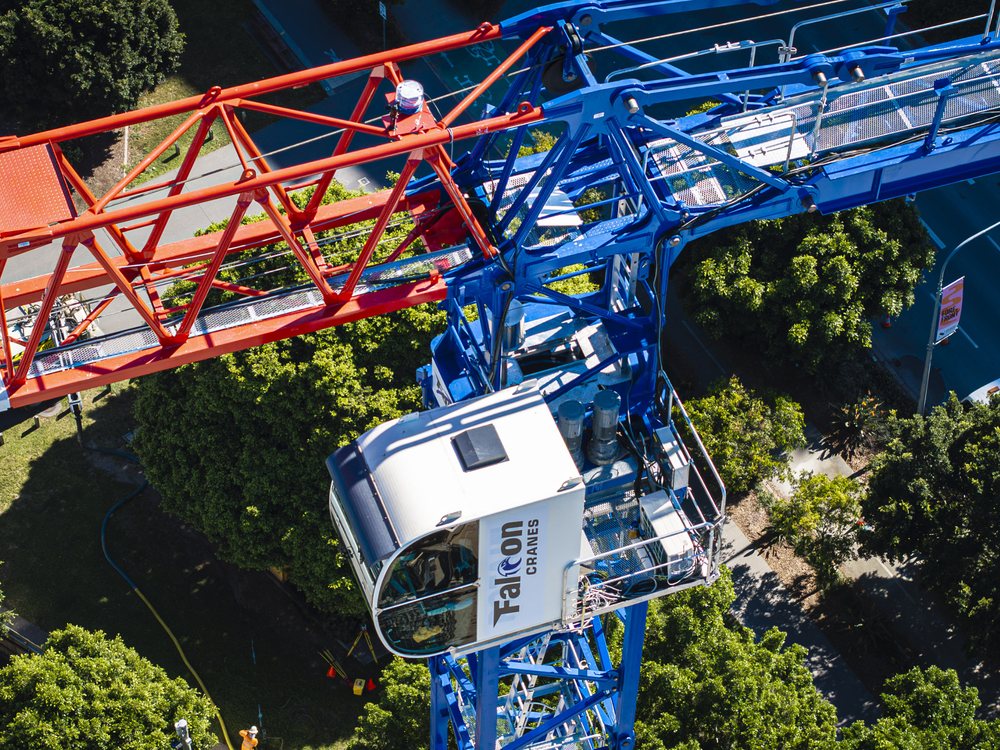
What the light is there to do
A tower crane is a tall, thin obstacle that aircraft need to see, at night and in poor visibility. An obstruction light at the top of the mast or the jib head marks it. The requirement comes from the approval conditions for your project — the height of the crane, how close the site is to a flight path or an aerodrome, and what the approving authority has written into the conditions. We supply to that spec rather than set it, so the quickest way to get the right fitting is to send us the wording of the condition.
Low intensity and medium intensity
Low-intensity red is the common case. The CK-15C is a steady-burning red light at 2,000 cd, 360° horizontal, running on 220–230 V AC or 24/48 V DC and drawing 30 W or less. There is a flashing version of the same body that draws about 2 W.
Medium intensity is for structures tall enough, or close enough to an approach, that a low-intensity light is not enough. That unit flashes white at over 20,000 cd by day and holds steady red at 2,000 cd at night, switching itself over on built-in GPS and a photocell. It is a bigger head — 8 kg against 3.5 kg — which the bracket and the member it mounts to have to carry.
Mains or solar
Running a supply to the top of a crane that climbs is not always the easy option. The CK-11L-TZ is a solar low-intensity red LED light: 6.5 V DC off its own panel, 3 W or less, flashing 20 to 60 times a minute, and it switches itself on at 100 lux. It goes up with no cable, which suits a crane, a temporary structure, or a mast where the supply is somewhere else. Where mains power is already at the top — and on a crane it usually is — the mains units are brighter and cheaper.
What to check against the site
- Sealing. IP66 on the mains units, IP65 on the solar one. Both are sealed for weather at height.
- Wind. The CK-15C is rated to 240 km/h and the solar unit to 80 m/s, which covers Australian coastal conditions on a standing crane.
- Temperature. −40 °C to +55 °C, so heat on a black steel member in a Queensland summer is not the limit.
- Service life. Over 100,000 hours on the LEDs. On a two-year job the light should outlast the crane's time on site, which matters when changing it means a climb.
- Weight. 1.2 kg solar, 3.5 kg low intensity, 8 kg medium intensity. Check it against the bracket and the fixing.
Brackets and mounting
The lights mount on stainless steel anchor-type brackets that rotate through 90°, in 338 × 290 mm and 268 × 220 mm. The rotation is the point: the member you are fixing to is rarely vertical, and the light has to sit upright to throw its beam where it is meant to go. Full specifications for every unit are in the aviation lighting product list.
Getting it on site with the crane
Aviation lighting is usually fitted when the crane is erected, because that is when you have the mobile crane and the crew at height. Order it with the crane and with any signage, so the three go up in one visit. Send us the approval condition, the crane model and the erection date through the enquiry form.
Common questions
Do I need an aviation light on my crane?
That is set by your project's approval conditions, which take account of the crane's height and how close the site is to a flight path. Send us the wording and we will match a fitting to it.
Can the light work without power at the top of the crane?
Yes. The CK-11L-TZ runs off its own solar panel at 3 W or less and needs no cable to the top.
Does someone have to switch it on and off?
No. Every unit has a built-in photocell, and the medium-intensity light uses GPS and a photocell to change between white flashing by day and steady red at night.
How long do the lights last?
Over 100,000 hours on the LEDs, which is longer than most cranes stand on one site.
Have a condition to meet? Send us the wording →